
Audio Production Essentials: How to Create Impact Hits
Updated June 18, 2021
Impact hits are one of the most widely used and in-demand sound design elements on the market. There are endless variants for audio engineers to explore on this production staple, and once you understand the basics of how this sound is made, you can create your own cinematic hits quickly and easily.
Layer Sounds to Create a Full Range of Frequencies and a Natural Sounding Attack
To get started creating a hit, you’ll want to layer various sounds, each one bringing an interesting sonic characteristic, and occupying a unique frequency range. For instance, sub-bass to occupy the bottom end, a low range kick, another kick with a high pass filter to occupy the mid-range, and other high-passed samples or signals to occupy the upper mids and high end.
Get creative with your samples if you see potential in a sound. Pitch shifting or reversing a sound will give you something brand new.
Listen closely and fine tune the timing of each sound’s attack so that they all fit together naturally. Instead of each sound hitting all at the exact same time, the sounds should come together to hit in a way that sounds organic, which will require some slight staggering to flam their attacks.
To create a natural sounding decay, some effects should sustain longer than others, and selecting which ones should ring out or die off can create radically different sounds.
Pitch envelopes or other types of processing automation on a track can bring tons of movement and character to a hit as well.
Finally, mix your levels on your tracks, and you’re ready for the final phases of processing.
Add Reverb and Delay
With the EQing finished on each track, all that’s left to add onto your impact hit is reverb and delay.
A good plate reverb can be an excellent choice for an impact hit, but ultimately there are no rules to selecting the specific reverb(s) that you apply to your hit, how wet or dry the signal is, or how much room you’d like to add to your sound.
An important attribute to consider when selecting a reverb is to ensure that it carries your low frequencies. Many reverbs leave out the low frequencies so that tracks don’t become muddy, but when dealing with a single hit like this, you’ll want the option to keep the lower body of the hit intact as the reverberation decays. One good option for your reverb is Convolution Reverb Pro from Max for Ableton Live, which will ensure sufficient rumble for your hit.
Finally, apply delay as liberally as you’d like. Layer different delays, or keep your hit on the short side. This last step is one of the most expressive, and requires the least amount of skill.
That’s it! Keep building hits and experiment with the vast possibilities available for designing this sound design staple.

How Music For Sport runs a 180-album catalog across territories
Music For Sport has supplied music to every Summer and Winter Olympic Games since 1992. More than three decades and 180-plus albums later, the UK company's job hasn't changed: put high-quality production music in front of broadcas...[ READ MORE ]


YouTube Shorts monetization is now live. Here's what else is new in June.
June was a build-heavy month across our licensing, YouTube, and Collect businesses. We launched a major upgrade to our music-monitoring service, invested in faster and more accurate royalty processing, moved several enterprise integrations...[ READ MORE ]

The operational side of maximizing catalog revenue
One of the clearest indicators of long-term catalog health is whether there’s a real system of record behind it. By that we mean: a single place where the rest of the business can quickly confirm what a work is, who owns it, what iden...[ READ MORE ]

May at a Glance: A Product Update, the Brief Inbox, and a New AI Podcast
The Brief Inbox didn't slow down in May, and neither did we. Column customization shipped, and Drew made an appearance on Morning Brew's new AI podcast to talk music and AI. Drew on The Intelligence Shift Drew Silverstein, our Presid...[ READ MORE ]
Why Brands Are Moving Toward Aggregator-Driven Music Licensing
The way music gets licensed for advertising is changing at the infrastructure level. More brands and agencies are moving toward aggregator-driven ecosystems, where platforms like SourceAudio plug directly into proprietary music discover...[ READ MORE ]

April Recap: Luminate Summit, Blog Post, and What's Coming Through the Brief Inbox
Andrew Talks AI Training Data at Luminate Summit On April 15, SourceAudio CEO and co-founder Andrew Harding joined Doug Shapiro, Dave Davis, Dustin Blank, and Matthew Adell on "The AI Training Data Economy" panel at the Luminate Dat...[ READ MORE ]
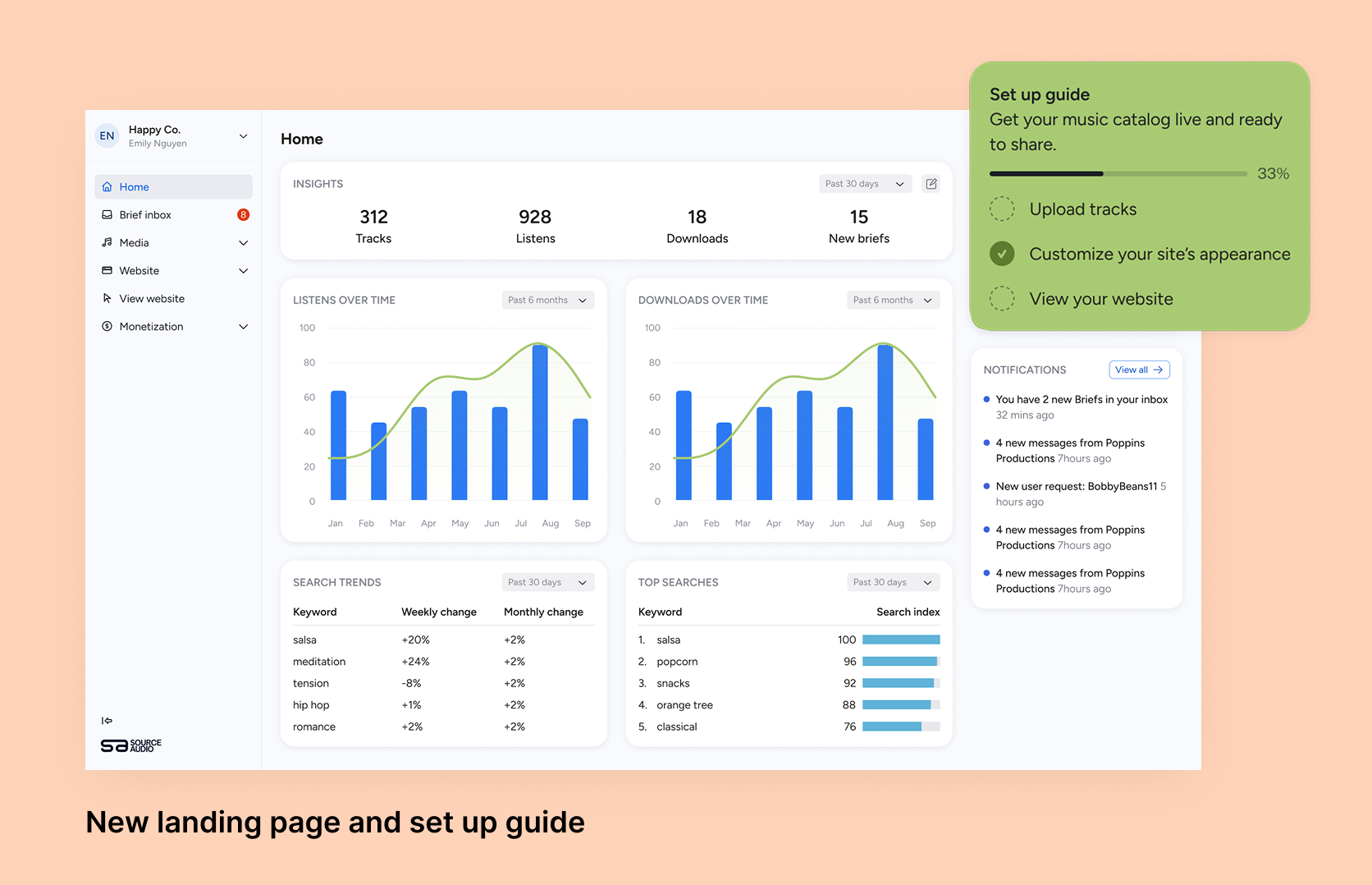
Fixing Foundations: How I restructured SourceAudio to be more intuitive for admins, new and old
For over a decade, SourceAudio has been adding features, expanding its reach, and growing alongside the music licensing industry. While our toolset has proven valuable to our client base, it’s important to acknowledge weaknesses that hav...[ READ MORE ]