
Major DSP Songwriter Payment Proposals to Begin in 2023 are Now Public
Updated November 5, 2021
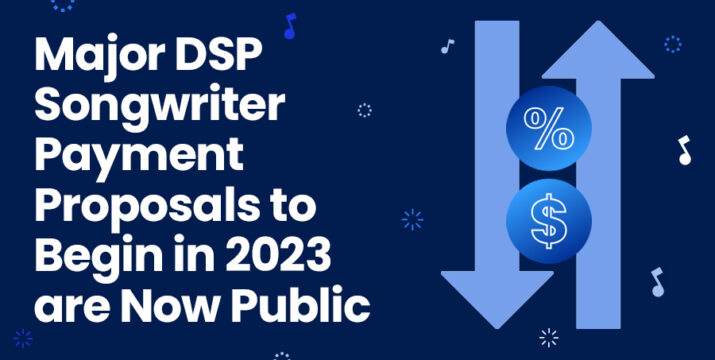
The once private proposals from the major streaming companies for their future songwriter royalty payments are now public.
With the 2017 royalty statutes expiring in 2022, the streaming payouts for 2023-2027 are now the subject of heated legal debate between the US Copyright Royalty Board, digital service providers such as Spotify, Apple, Amazon, Pandora, and Google, and musician advocacy groups such as the NMPA.
One of the most impactful numbers in the royalty payout calculation for DSPs is known as the headline rate, which refers to the portion of a DSP’s annual revenues paid to songwriters.
The rate has previously been set by the US Copyright Royalty Board at 15.1%, and the NMPA is now requesting that the headline rate be increased to 20%. Spotify, Amazon and Google all appealed this raise.
Spotify, Apple, Pandora, and Google, have all countered the raise, proposing a return to a previous headline rate of 10.5%, except for Amazon Music which proposed 10.54%.
Musician advocacy groups are further concerned with transparency surrounding the revenue figure used to calculate the headline payment. NMPA CEO David Israelite and Executive Director of the Nashville Songwriters Association International Bart Herbison are addressing the issue by advocating for additional revenue streams to be built into the deal.
One of these payment plans would be a Total Cost of Content (TCC) percentage which would require DSPs to pay publishers at least a set percentage of what they pay to the labels. The rates for TCC have been the subject of much debate, as the US Copyright Royalty Board ruled to increase TCC percentage by ~1% each year from 22% in 2018 through 2022 until it hit 26.2%.
Amazon’s proposals get even more complex, forgoing TCC for “an all-in floor of 80 cents per subscriber per month for the standalone portable tier, and 40 cents per subscriber for the less-expensive non-portable tier”, among other revenue streams.
The Music Modernisation Act, which was signed into law on October 11, 2018 through the US House and Senate with unanimous support, obligates the US Copyright Royalty Board’s 2023-2027 royalty rates mandates to use the “willing buyer, willing seller” standard to ensure a fair arrangement.
Currently, there’s still work to be done before the two parties are able to reach a willing consensus.

The Brief Inbox is officially live in your SourceAudio workspace!
It’s a new, shared workflow designed to make briefing, pitching, and licensing clearer on both sides of the process. Networks and production teams can request music more efficiently, and catalogs can respond with focused, relevant pit...[ READ MORE ]

Your SourceAudio June Recap: Ethical AI, Real Revenue & What’s Coming Next
It’s been a huge month. Here's a quick look at how we're pushing the industry forward. Ethically, strategically, and always with creators at the core. New: AI Dataset Licensing Marketplace We launched the first scalable, fully clea...[ READ MORE ]



SourceAudio Celebrates Record-Breaking 2024
As we wrap up 2024, SourceAudio has solidified its position as the system of record and single source of truth for the music licensing industry. Through unprecedented growth and democratization of cutting-edge music technology tools, our p...[ READ MORE ]