
How to Use Automation to Enhance the Musicality of Your Track
Updated October 18, 2022
Use volume or eq automation to add depth to elements in your productions.
Adding dynamic, automated EQ or volume can add a ton to recordings or synthesized sound.
With volume automation, you can create percussive, attack-heavy rhythms, or use long, smooth automations to create swells. This can be the performance in itself, but if you have a performance that has come out a bit monotone, or isn’t really popping the way you want it to, this kind of automation can take the motion of the performance to the next level. Just use the automation to boost on the emphasis, and listen to the difference.
Same idea with EQ. The contrast of a filter being turned up or down in unison with the performance itself can add a whole new dimension to take your track to the next level.
For example, you can use drastic, quick automation over a steady held chord over a one or two bar phrase, then, loop, that phrase, to get a rich, interesting sound, from what was previously a static sound.
This can also enter into the territory of side chaining. By making dips in your tracks’ volume—except for one instrument sounding on its own during the dip—you can create a drastic impact and let a key element in a track shine without having to turn the volume up through the roof.
Of course you can use automation to bring in or out any effect over any period of time. Reverb, delay, and saturation are all great candidates, but volume and EQ are the two that can be used in rapid flux to create groove and motion.
Automation is an incredibly flexible, tool, and its applications are as expensive as the imagination of the user. Get comfortable with automation and enjoy the myriad of possibilities it brings to your productions.

How Music For Sport runs a 180-album catalog across territories
Music For Sport has supplied music to every Summer and Winter Olympic Games since 1992. More than three decades and 180-plus albums later, the UK company's job hasn't changed: put high-quality production music in front of broadcas...[ READ MORE ]


YouTube Shorts monetization is now live. Here's what else is new in June.
June was a build-heavy month across our licensing, YouTube, and Collect businesses. We launched a major upgrade to our music-monitoring service, invested in faster and more accurate royalty processing, moved several enterprise integrations...[ READ MORE ]

The operational side of maximizing catalog revenue
One of the clearest indicators of long-term catalog health is whether there’s a real system of record behind it. By that we mean: a single place where the rest of the business can quickly confirm what a work is, who owns it, what iden...[ READ MORE ]

May at a Glance: A Product Update, the Brief Inbox, and a New AI Podcast
The Brief Inbox didn't slow down in May, and neither did we. Column customization shipped, and Drew made an appearance on Morning Brew's new AI podcast to talk music and AI. Drew on The Intelligence Shift Drew Silverstein, our Presid...[ READ MORE ]

Why Brands Are Moving Toward Aggregator-Driven Music Licensing
The way music gets licensed for advertising is changing at the infrastructure level. More brands and agencies are moving toward aggregator-driven ecosystems, where platforms like SourceAudio plug directly into proprietary music discover...[ READ MORE ]

April Recap: Luminate Summit, Blog Post, and What's Coming Through the Brief Inbox
Andrew Talks AI Training Data at Luminate Summit On April 15, SourceAudio CEO and co-founder Andrew Harding joined Doug Shapiro, Dave Davis, Dustin Blank, and Matthew Adell on "The AI Training Data Economy" panel at the Luminate Dat...[ READ MORE ]
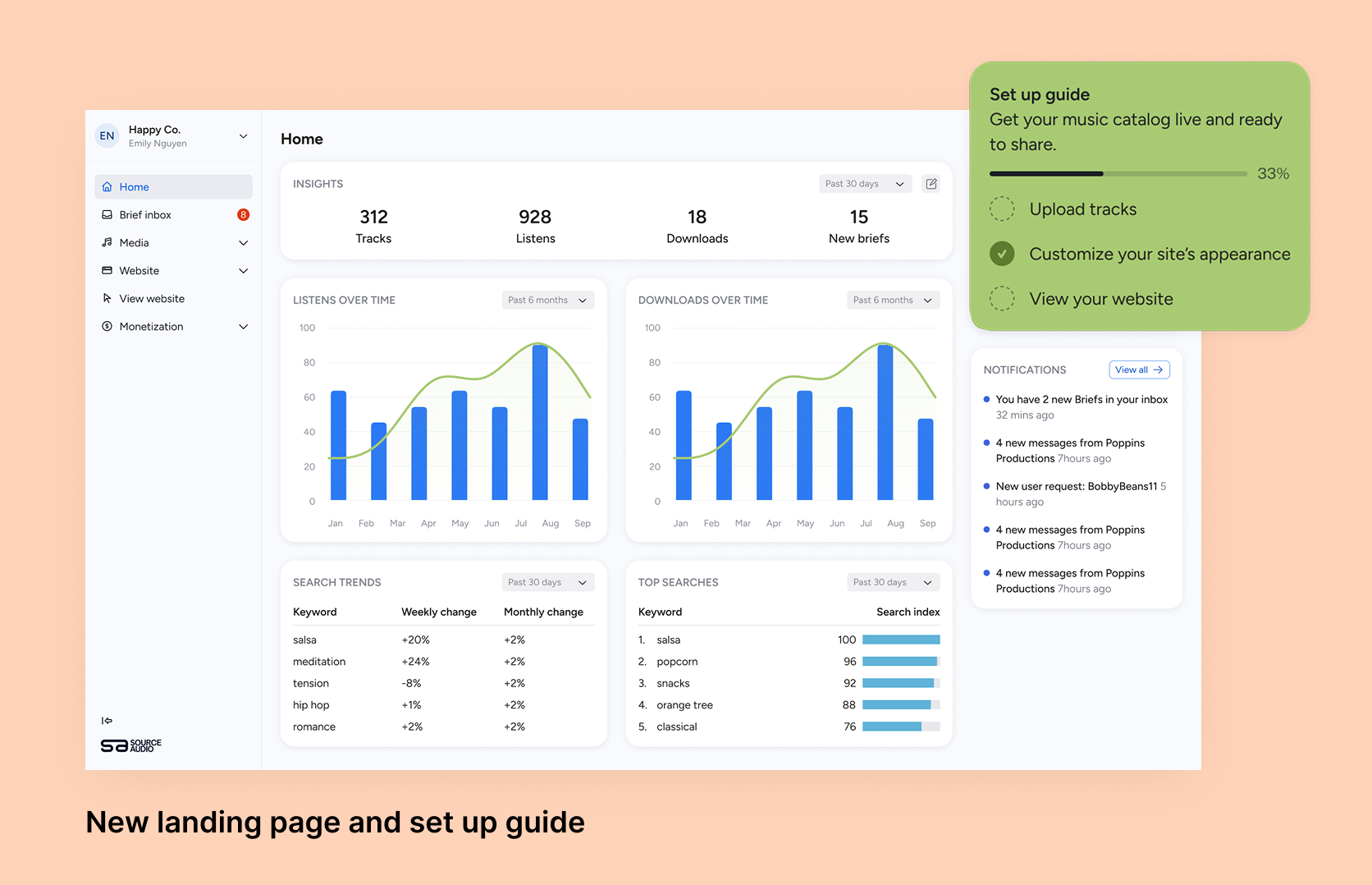
Fixing Foundations: How I restructured SourceAudio to be more intuitive for admins, new and old
For over a decade, SourceAudio has been adding features, expanding its reach, and growing alongside the music licensing industry. While our toolset has proven valuable to our client base, it’s important to acknowledge weaknesses that hav...[ READ MORE ]