
LUFS: The Industry Standard for Setting Audio Levels
Updated December 18, 2020
dB levels don’t tell the whole story. LUFS are used in mixing, mastering, and broadcast standards to set truly consistent audio levels for human perception.
The Loudness War
“The loudness war” has had a massive impact on the development of music production over the past 70 years. The concept originated from the observation that records cut at a louder volume would get more plays on jukeboxes, but options for boosting perceived loudness were limited at that time due to physical limitations of vinyl records. The advent of CDs and other modern music production technologies largely did away with those limitations and marked the beginning of an endless race to create the loudest sounding tracks possible.
As loudness became an issue, the regulation of these audio levels in broadcasting was originally handled by a team of sound operators who used both their ears and console meters to manually mix even levels. Over the years, these workers were replaced by automated programs which made mix adjustments based on the broadcast standard Permitted Maximum Level (PML), and it wasn’t long before advertisers realized they could cheat this system to create heinously loud sounding mixes through the use of heavy compression.
The industry needed a new way to measure audio, and thus, LUFS were created to satisfy this need.
What are LUFS?
LUFS stands for Loudness Units relative to Full Scale and is still the latest and most accurate technology available for measuring perceived audio loudness. Today LUFS are used to set audio level standards in film, broadcast television, radio, and on streaming platforms like Spotify and Apple Music.
For example, YouTube and Spotify both stream audio at around -14LUFS.
While prior systems based their mix levels on audio peaks, LUFS employ a more advanced analysis of the signal to more accurately account for human perception. Measurement in LUFS also creates mixes that sound better and more consistent across the wide variety of sound systems that media is consumed on.
Listed below are various important values in a sound mix, all of which are measured in LUFS (unless otherwise noted).
Integrated Loudness helps a sound editor determine how much louder a loud scene should be in comparison to a quiet scene. Since the sonic qualities of those two scenes are very different, LUFS provide the most accurate information possible.
Dynamic Range is similar to integrated loudness, as it refers to the difference between the loudest moments of sound in a track and the quietest moments of sound. Since the data is all in the same track, it’s actually measured in LU, not LUFS.
Short term LUFS offer a closer view on a small section of a track to fine tune bits of the track that might otherwise miss the mark for loudness.
Momentary LUFS refers to the shortest possible period of LUFS measurement and typically measures across 400 ms of audio.
The advanced applications of these values come into play most of all in mastering. Audio measurement in LUFS has become an indispensable tool to guide the mastering process so that mastering engineers are able to push volume levels to their technical limit without ever exceeding it.
All of these applications work together to ensure that the audio sounds consistent and full across the entire span of the production and on any sound system.

How Music For Sport runs a 180-album catalog across territories
Music For Sport has supplied music to every Summer and Winter Olympic Games since 1992. More than three decades and 180-plus albums later, the UK company's job hasn't changed: put high-quality production music in front of broadcas...[ READ MORE ]


YouTube Shorts monetization is now live. Here's what else is new in June.
June was a build-heavy month across our licensing, YouTube, and Collect businesses. We launched a major upgrade to our music-monitoring service, invested in faster and more accurate royalty processing, moved several enterprise integrations...[ READ MORE ]

The operational side of maximizing catalog revenue
One of the clearest indicators of long-term catalog health is whether there’s a real system of record behind it. By that we mean: a single place where the rest of the business can quickly confirm what a work is, who owns it, what iden...[ READ MORE ]

May at a Glance: A Product Update, the Brief Inbox, and a New AI Podcast
The Brief Inbox didn't slow down in May, and neither did we. Column customization shipped, and Drew made an appearance on Morning Brew's new AI podcast to talk music and AI. Drew on The Intelligence Shift Drew Silverstein, our Presid...[ READ MORE ]

Why Brands Are Moving Toward Aggregator-Driven Music Licensing
The way music gets licensed for advertising is changing at the infrastructure level. More brands and agencies are moving toward aggregator-driven ecosystems, where platforms like SourceAudio plug directly into proprietary music discover...[ READ MORE ]

April Recap: Luminate Summit, Blog Post, and What's Coming Through the Brief Inbox
Andrew Talks AI Training Data at Luminate Summit On April 15, SourceAudio CEO and co-founder Andrew Harding joined Doug Shapiro, Dave Davis, Dustin Blank, and Matthew Adell on "The AI Training Data Economy" panel at the Luminate Dat...[ READ MORE ]
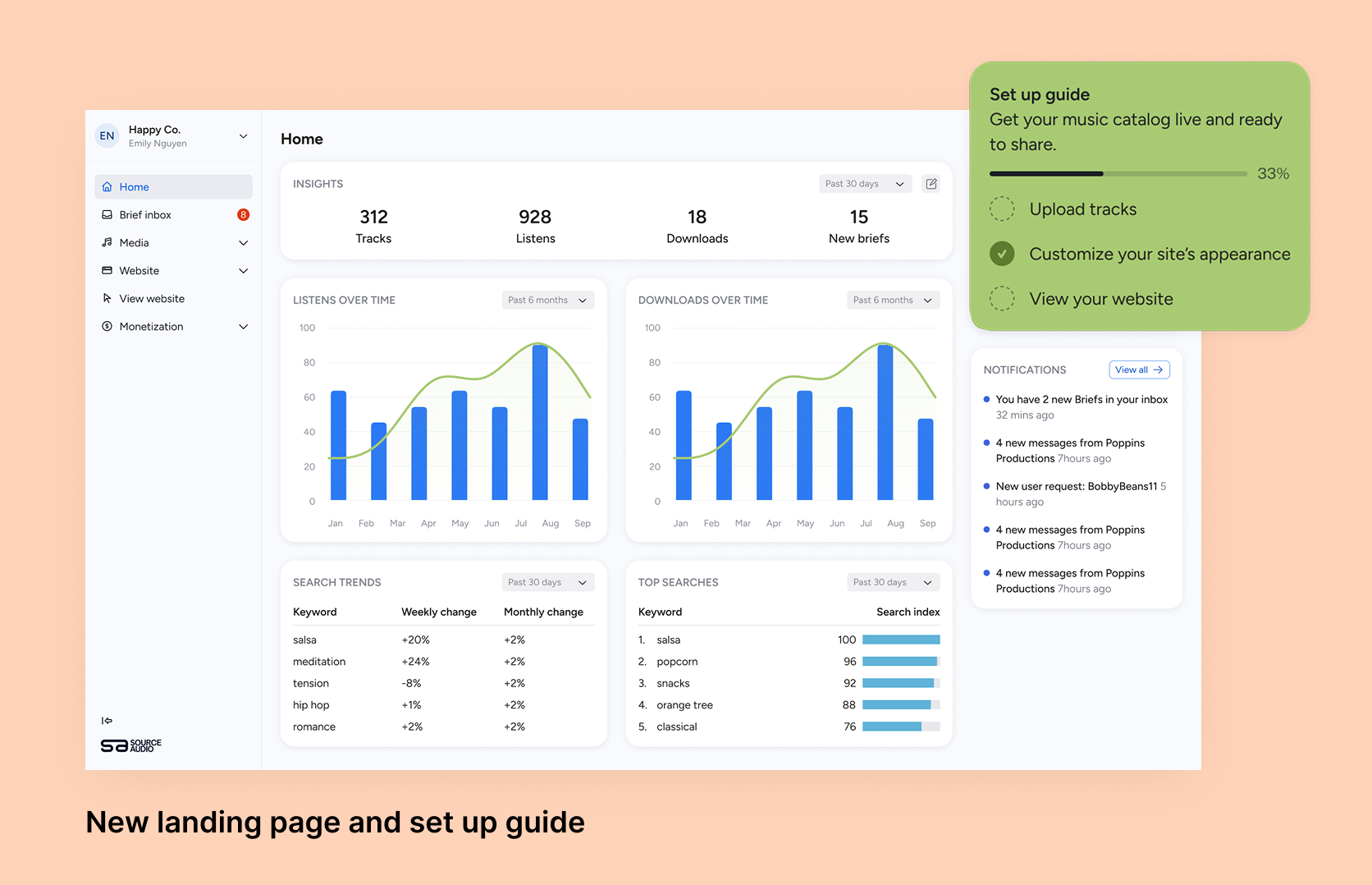
Fixing Foundations: How I restructured SourceAudio to be more intuitive for admins, new and old
For over a decade, SourceAudio has been adding features, expanding its reach, and growing alongside the music licensing industry. While our toolset has proven valuable to our client base, it’s important to acknowledge weaknesses that hav...[ READ MORE ]