
An Introduction to EQing in Mixing
Updated August 12, 2022
Professional grade EQing can make a great track sound even better, while a bad EQ job can absolutely ruin an otherwise great recording. Here are a couple of useful EQing techniques to take your mix to the next level.
EQ to Avoid Overlapping Frequencies
Fundamentally, a mixing engineer wants to make sure that overlapping of instruments in any frequency range is reduced to a minimum. Each instrument in a mix should occupy its own unique frequency range so that the mix doesn’t sound muddy and each voice has plenty of room to sound out.
To achieve this, the engineer uses broad frequency cuts, two on an instrument at most, and the best way to get started with this process is to begin with the most important instruments in the mix. You’ll give your most important instrument priority for the frequencies that make it sound the best, and then go to the second most important frequency, and so on. Ideally, the instruments should already have been chosen so that each one works together to form a complete spectrum of sound from the lowest audible frequency to the highest, so this process shouldn’t involve reshaping the sounds too much.
Removing Dissonant Harmonics
One of the most common tricks that engineers use to make instruments sound both louder and clearer is the removal of dissonant frequency harmonics. This is accomplished by using a graphic EQ, boosting a set frequency with your Q-value turned all the way up, and then slowly sweeping across the entire frequency spectrum to listen for dissonant harmonics that ring out. Once you have identified them, take that boosted EQ frequency and drop it all the way down to cut it to the level which sounds best.
You may want to take this a step further and engage the piano roll across the bottom of your frequency visualizer if you have one. You may find that those trouble frequencies you cut out end up aligning with notes that are not in the key of your song. With the piano roll, you can lock those nodes of your cuts onto the dissonant notes, which may provide an even more effective cut.
Like most mixing tools, the effect is subtle, and it’s best not to overdo it and punch too many holes in your instrument, but many subtle improvements on each track over of a mix go a long way to elevating a track.

How Music For Sport runs a 180-album catalog across territories
Music For Sport has supplied music to every Summer and Winter Olympic Games since 1992. More than three decades and 180-plus albums later, the UK company's job hasn't changed: put high-quality production music in front of broadcas...[ READ MORE ]


YouTube Shorts monetization is now live. Here's what else is new in June.
June was a build-heavy month across our licensing, YouTube, and Collect businesses. We launched a major upgrade to our music-monitoring service, invested in faster and more accurate royalty processing, moved several enterprise integrations...[ READ MORE ]

The operational side of maximizing catalog revenue
One of the clearest indicators of long-term catalog health is whether there’s a real system of record behind it. By that we mean: a single place where the rest of the business can quickly confirm what a work is, who owns it, what iden...[ READ MORE ]

May at a Glance: A Product Update, the Brief Inbox, and a New AI Podcast
The Brief Inbox didn't slow down in May, and neither did we. Column customization shipped, and Drew made an appearance on Morning Brew's new AI podcast to talk music and AI. Drew on The Intelligence Shift Drew Silverstein, our Presid...[ READ MORE ]

Why Brands Are Moving Toward Aggregator-Driven Music Licensing
The way music gets licensed for advertising is changing at the infrastructure level. More brands and agencies are moving toward aggregator-driven ecosystems, where platforms like SourceAudio plug directly into proprietary music discover...[ READ MORE ]

April Recap: Luminate Summit, Blog Post, and What's Coming Through the Brief Inbox
Andrew Talks AI Training Data at Luminate Summit On April 15, SourceAudio CEO and co-founder Andrew Harding joined Doug Shapiro, Dave Davis, Dustin Blank, and Matthew Adell on "The AI Training Data Economy" panel at the Luminate Dat...[ READ MORE ]
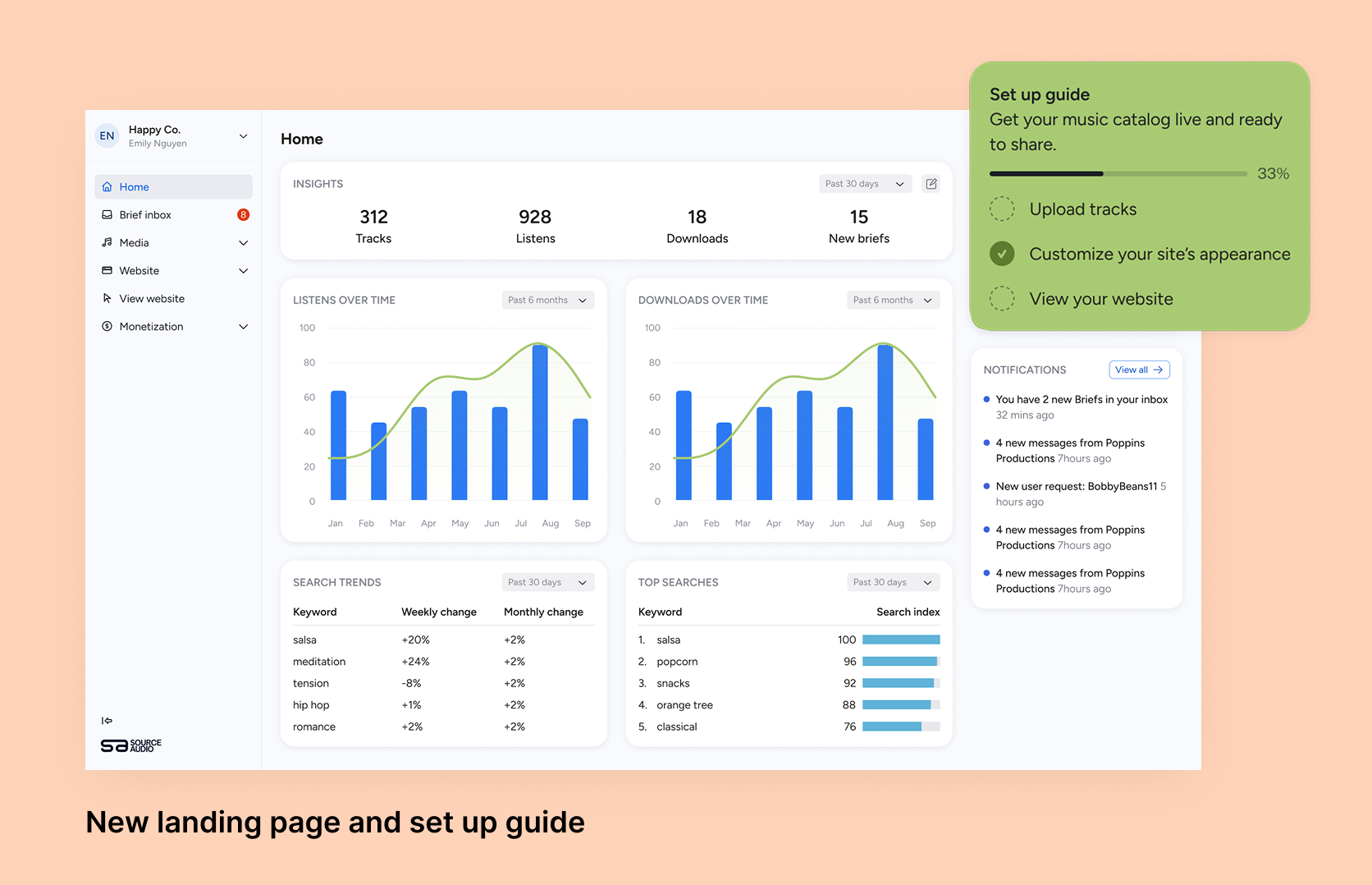
Fixing Foundations: How I restructured SourceAudio to be more intuitive for admins, new and old
For over a decade, SourceAudio has been adding features, expanding its reach, and growing alongside the music licensing industry. While our toolset has proven valuable to our client base, it’s important to acknowledge weaknesses that hav...[ READ MORE ]